
Pièces justificatives (essay)
Evidence of singing of protestant spiritual songs (hymns) in the early 16th century
Singing in church
Strasbourg-Genève
Strasbourg, Late 1525 (Girard Roussel)
A quinta matutinà adusque sextam habetur concio in singulis templis communesque funduntur preces. Deinde septima horá idem rursus fit, octava verò hora ante omnia concio fit in maiori templo, adiunctis cantionibus in communem linguam ex hebraico psalterio transfusis, ubi mire assonant mulieres viris ut iucundum sit audire.
In eodem quoque templo rursus fit concio hora quarta a prandio, non prætermissis autem cantionibus quæ præcurrant et subsequantur sermonem, veluti hisce gratiam postulantes qua fiant idonei excipiendo semini evangelico , et susceptum suis prosequantur gratiis.
From five in the morning until six, a service is held [concio, a congregational gathering] in every church and common prayers are offered. Then at seven o’clock the same takes place again. But at eight o’clock, above all, a gathering takes place in the principal church, to which songs [cantionibus] are added, translated into the vernacular from the Hebrew Psalter, where the women blend their voices [assonant] with the men so wonderfully that it is a delight to hear.
In the same church, there is another gathering at four PM, once more also including songs which precede and follow the sermon— as though by these they first seek the grace by which they may be rendered fit to receive the seed of the Gospel, and, having received it, may respond with fitting thanksgiving
Letter written from Strasbourg, by Girard Roussel to his Bishop, Guillaume Briçonnet (Meaux). The letter is undated, but after the collapse of the cercle de Meaux (Reformation experiment in the Diocese of Meaux) the main protagonists had fled to Strasbourg, arriving early October 1525. Lefèvre d’Étaples went to Basel in January, 1526. Roussel’s biographer, C. Schmidt, assumes Roussel accompanied him. Mid-april Marguerite d’Angoulême (the King’s Sister) recalled Lefèvre d’Étaples, and appointed him royal librarian and tutor to the younger royal children. Roussel joined the court of Marguerite d’Angoulême and became Marguerite’s court preacher and later her personal almoner (aumonier), finally Bishop of Oloron. He is the one who preached the famous ‘Lenten sermons’ in the Louvre in 1533, and who is viciously attacked by Calvin in 1537 as a ‘dissimulator’ (the second of the Epistolae Duae is (without mentioning his name) addressed to Roussel).
Source: C. Schmidt, Gérard Roussel, prédicateur de la reine marguerite de Navarre (Paris/Strasbourg/Geneve : 1845). p. 188 -191 [Pièces justificatives VI]. Autograph manuscript. Bibliothèque de Genève. [at least it was there, when Schmidt transcribed it]
Strasbourg, between october 1545 and february 1546 (Hubert de Bapasme)
… Il faict ichy chier vivre : il fault ung sept libvres de gros pour an. Toutesfois vous ne croiriés jamais que c’est une chose plaisante et sy est on a repos de conscience quand on est où la parolle de Dieu est purement anoncée et les sacrements purement distribués, ausy quant on oyt chanter les belles psaulmes et merveilles du Seigneur. Je fust bien au commen chement cincq ou six jours, quant je oioie chanter, je ne me savoie tenir de pleurer de joye. Vous ny oieriez point une vois desborder l’autre. Chascun a ung libvre de musicque en sa main, tant homme que femme, chascun loue le Seigneur. »
…Living here is expensive: one needs about seven pounds gros per year. Yet you would never believe how delightful it is, and how greatly one’s conscience is at peace, when one is where the Word of God is proclaimed in purity and the sacraments are administered purely; likewise when one hears the beautiful psalms and the wonders [or mighty works – merveilles] of the Lord being sung: during the first five or six days, whenever I heard the singing, I could not keep myself from weeping for joy. You would not hear a single voice overpower another. Everyone has a music book in hand, men and women alike; each one praises the Lord.”
Hubert de Bapasme, refugee from Lille, writing to a friend or relative Jehan de Bois (we don’t know anything about both). Hubert uses ‘Martin du Mont’ as pseudonyme. The ‘draft’ of this letter has survived because Conrad Hubert (diaconus of the St. Thomas, Bucer ‘right-hand’) used the paper to write drafts of his own letters in the margin and verso. First published in 1886 (Alfred Erichson), reedited in 1964 (Jean Rot). Complete transcription and ‘identification’ of the writer as Hubert de Bapasme (Bapaume) by Philippe Denis (1978). Philippe Denis, La correspondance d’Hubert de Bapasme, réfugié lillois à Strasbourg (1545–1547). Bulletin de la Société de l’Histoire du Protestantisme Français
PART I: BSHPF 124 (1978), 84–112
PART II: BSHPF 125 (1979), 288–313.
Letter IV in Part I. The dating of the letter is based on internal evidence in the correspondence.
Genève late october 1548 (Théodore de Bèze)
Agitur annus tricesimus primus ex quo per Dei gratiam ultro patriam meaque omnia reliqui ut Christe libere servirem. Accidit autem mihi tunc primum in publicum Christianorum vestigium ponenti, ut hunc Psalmum coetus (+ ipse] concineret, cujus cantu, perinde ac si Deum ipsum audirem me proprie compellantem, ita me sensi recreari, ut illum ab eo tempore habuerim intime pectori meo insculptum: et hoc vero coram Deo testari possim, ex eius meditatione me non tantum, quum essem etiam [+ triennio post] peste correptus, et idem malum familiam meam [quod quater factum est] invasisset, verum etiam in gravissimis aliis tentationibus, mirificam laevationem aegritudinis ac doloris ex eo percepisse.
Thirty-one years have now passed since, by the grace of God, I voluntarily left my homeland and everything I owned so that I might serve Christ freely. It happened to me then, when I was first stepping into a public gathering of Christians, that the congregation itself was singing this Psalm; by its singing—just as if I were hearing God Himself speaking to me personally—I felt so revived that from that time on, I have kept it deeply engraved upon my heart. And indeed, I can testify before God that from meditating upon it, I received a wonderful lifting of my sickness and grief—not only when I was afflicted by the plague [three years later], and when the same evil attacked my family (which happened four times), but also in other most grievous trials.
CL Psalmorum Davidis….libri V, Antverpiae, Nicol. Barium, 1580, p. 393: “In Psalmum 91 Argumentum et usus”. Between square brackets the additions from the Geneva edition of 1581. Bèze and his girl-friend Claudine Denosse arrived in Geneva aroudn 23 October 1548.
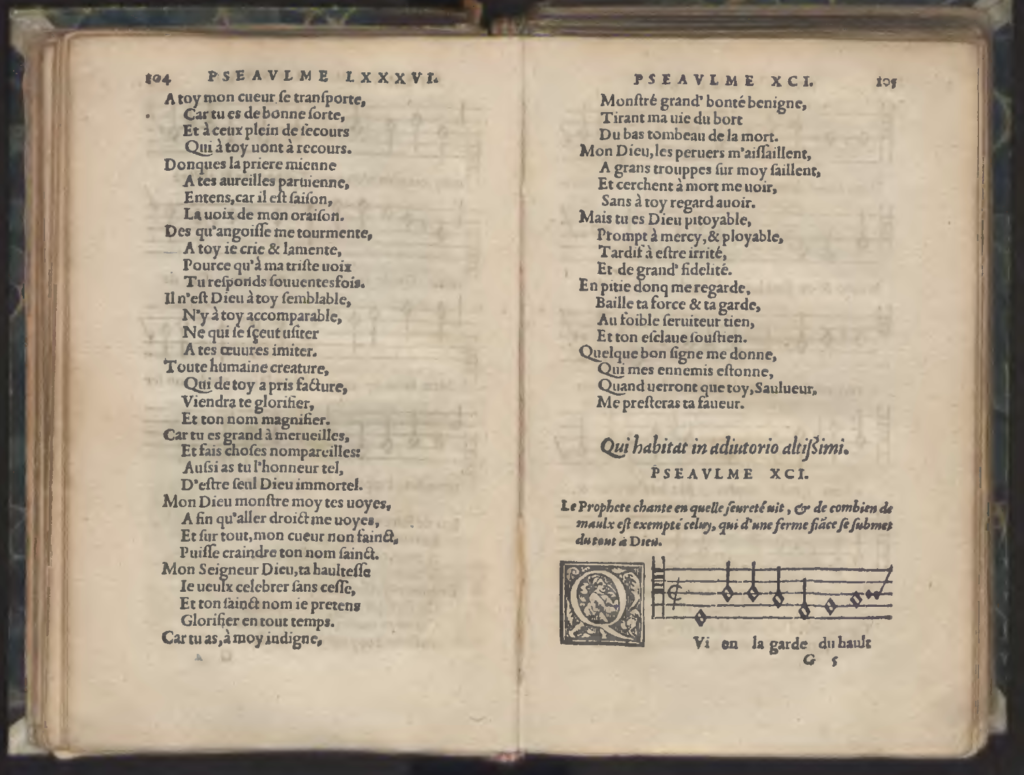
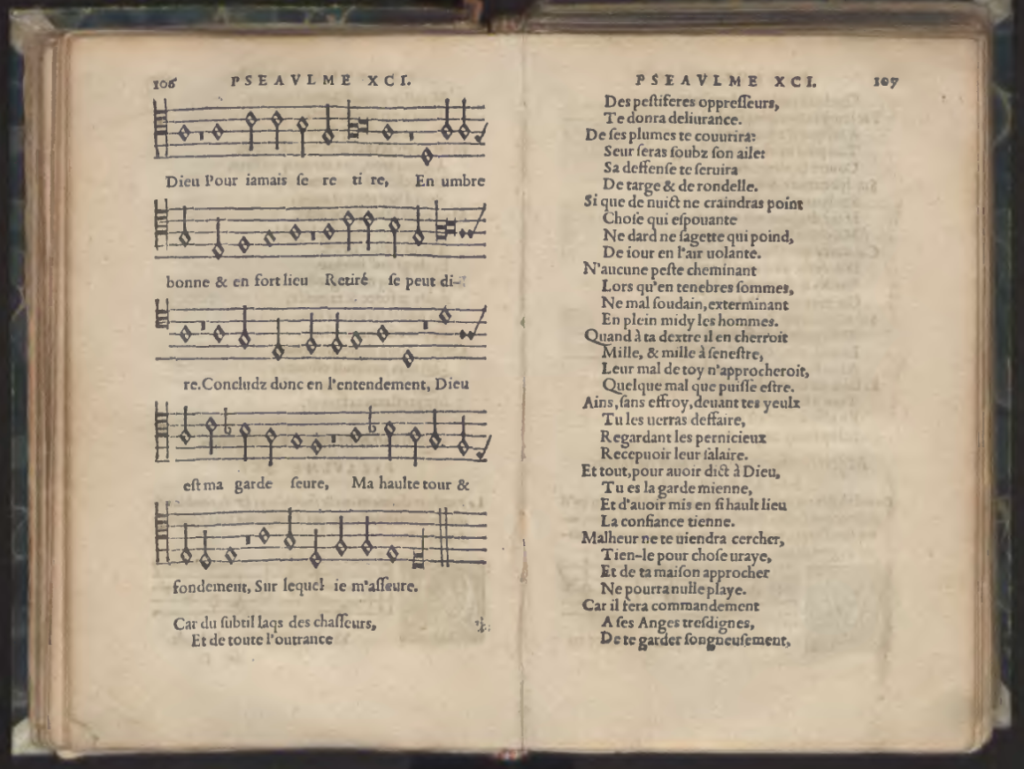
Below the Psalm that was sung: Qui en la garde du haut Dieu / pour jamais se retire, / en umbre bonne & en fort lieu / retiré se peut dire. (with a really beautiful tune – photo from a Lyon edition of the Psalms, published in 1548).
Wolfgang Musculus – Lutheran Masses 1536
Eisenach 14 May 1536 (Ordinary Sunday Mass)
Dominica Cantate.
Hora septima ingressi sumus Ecclesiam vbi officium Missae vt vocant ad modum sequentem habebatur :
Primum canebatur latine a pueris et ludi magistro Introitus nempe cantate domino, per omnia more papistico seorsim in choro. Postea adiungebatur Kirie eleyson , ludente quodam alternis in organo. Tertio Minister quidam more papistico indutus , altari similiter adornato positis luminibus et alijs adstans canebat latine Gloria in excelsis Deo, quam cantionem explebant vicissim chorus et qui ludebat organis. Qua finita canebat minister collectam quandam , vt vocant , germanice verso ad altare vultu et tergo ad populum , cui subiungebat ad populum versus lectionem quandam ex Epistola Jacobi, germanice.
Deinde rursus ludebatur in organis, succinente choro, victimae paschali etc. populo vero intercinente Christ ist erstanden .
Sub haec Canebat minister lectionem Euangelij germanice nempe , Nunc vero vado ad eum qui me misit , verso ad populum vultu. Post hanc lectionem ludebatur in organis , succinente Ecclesia, wir glauben all in eynen Gott.
His ita peractis concionabatur Justus Menius sine aliqua praecipua veste vulgariter indutus.
Finita contione admonebat altaris minister Sacerdotaliter indutus ad orandum pro quibusdam necessitatibus specialiter recensitis , adiuncta christi promissione , quicquid oraueritis patrem etc. Dein admonebat paucis de institutione Coenae , mox canebat verba coenae , primum de pane sub quae panem eleuabat omnino more papistico flexis a populo genibus, deinde calice , quem finitis christi verbis similiter eleuabat. Quibus expletis ludebatur in organis et canebatur vicissim a choro Agnus Dei et interea communicabatur , calicem porrigente quodam ministro vulgariter induto , ad quam communionem ne vnus quidem vir accedere visus est , sed paucae quaedam mulierculae communicabant.
Post quas communicabat et ipse altaris minister adorato primum pane, calice vero nequaquam, quem diligenter ebibit et denuo infuso vino mundauit , nequid sanguinis superesset.
Post Communionem canebat orationem quandam verso vultu ad altare , qua finita populum dimittebat cum benedictione quadam decantata verso ad populum vultu.
Postremo omni abeunte populo canebat Chorus germanice. Da pacem domine etc. atque finita erat ista actio .
Vesperae vero habebantur hora prima pomeridiana per omnia ad morem papisticum in choro, nisi quod lectio Euangelii diei Dominicae vulgariter a puero canebatur ad populum e sublimi et post vesperas contio habebatur de altero praecepto nempe, Non vsurpabis nomen Domini Dei tui in vanum etc. postquam canebatur christ ist erstanden.
At the seventh hour, we entered the church where the service of the Mass, as they call it, was held in the following manner:
First, the Introit—namely, Cantate Domino—was sung in Latin by the boys and the schoolmaster, entirely in the popish manner, apart in the choir. Afterward, the Kyrie eleison was added, with someone playing alternatim on the organ. Thirdly, a certain minister, dressed in the popish manner, standing before an altar similarly adorned with candles and other things placed upon it, sang in Latin Gloria in excelsis Deo, which song the choir and the organist performed in turn. When this was finished, the minister sang a certain collect, as they call it, in German, with his face turned toward the altar and his back to the people; to this, turning toward the people, he added a certain reading from the Epistle of James, in German.
Then there was playing on the organ again, with the choir singing along, Victimae paschali, etc., while the people joined in singing [Lat: intercinente – alternatim] Christ ist erstanden
Following this, the minister sang the Gospel reading in German—namely, Nunc vero vado ad eum qui me misit [But now I go to Him who sent me]—with his face turned toward the people. After this reading, there was playing on the organ, with the congregation singing along [succinente], Wir glauben all in einen Gott [We all believe in one God].
When these things had been thus performed, Justus Menius preached a sermon, dressed in ordinary clothes without any special vestment.
When the sermon was finished, the minister of the altar, dressed in priestly attire, admonished [the people] to pray for certain specifically enumerated necessities, adding Christ’s promise, Whatever you ask the Father, etc. Then he briefly admonished them concerning the institution of the Supper, and soon sang the words of the Supper: first concerning the bread, during which he elevated the bread entirely in the popish manner, with the people bending their knees; then concerning the chalice, which he similarly elevated when Christ’s words were finished. When these things were completed, there was playing on the organ, and the choir sang in turn the Agnus Dei, and meanwhile Communion was administered, with a certain minister dressed in ordinary clothes offering the chalice; at this Communion, not a single man was seen to approach, but a few poor women received Communion.
After them, the minister of the altar himself also received Communion, having first adored the bread, but by no means the chalice, which he carefully drank up and cleansed by pouring in wine again, lest any of the blood [Dat staat er echt!] should remain.
After Communion, he sang a certain prayer with his face turned toward the altar, and when it was finished, he dismissed the people with a certain chanted blessing, with his face turned toward the people.
Finally, as all the people were leaving, the choir sang in German, Da pacem domine [Give peace, O Lord], etc., and that service was finished.
Vespers, however, were held at the first hour of the afternoon, entirely according to the popish manner in the choir, except that the Gospel reading of the Lord’s Day was sung in the vernacular to the people by a boy from on high, and after Vespers a sermon was held on the second commandment, namely, You shall not take the name of the Lord your God in vain, etc., after which Christ ist erstanden was sung.
SOURCE: Wolfgang Musculus, “Itinerarium conventus Isnachii.” 1536. Manuscript in the Bern Stadtbibliothek, published by/in Theodor Kolde, ed., Analecta Lutherana: Briefe und Actenstücke zur Geschichte Luthers(Gotha, 1883), 216-218
Wittenberg 28 May 1536 (Mass on Sunday Exaudi)
1536: Wolfgang Musculus (pastor at Augsburg) describes the Mass on Sunday Exaudi, with all prominents present (special occasion, so extra-ordinary I presume).
28. Maij dominica Exaudi.
Hora quinta concionatus est M. Mathaeus Reutlingensis de Baptismate. […]
Hora sexta habita est concio in arce.
Hora septima rursus templum commune ingressi, vidimus quo ritu τὴν λειτουργίαν celebrarint Nempe isto: Primum ludebatur Introitus in organis succinente choro latine, more sacrificorum atque interea e sacrario progrediebatur minister sacrificaliter indutus flexisque ante altare genubus cum adiuncto famulo aedituo confitebatur et post confessionem ad altare ascendebat, ad librum qui erat more papistico ad dexteram locatus.
Post introitum ludebatur in organis et vicissim canebatur a pueris kyrie eleyson, quo completo cantabat minister gloria in excelsis, quod canticum vicissim complebatur in organis et choro. Sub ista canebat minister in altari Dominus vobiscum, respondebat chorus et cum spiritu tuo. Subiungebatur collecta eius diei latine, deinde succinebat Epistolam latine, post ludebatur in organis subiungente choro Herr Gott vatter wohn vns bey etc. quo completo a ministro Euangelium eius dominice in parte altaris sinistra, vt solent Pontificij idque latine. Postea ludebatur in organis et a choro subiungebatur, wir glauben all an eynen Gott, quam cantionem sequebatur Contio, quam habebat Bucerus de Euangelio eius Dominicae praesente Luthero et Philippo. Post Contionem canebat chorus latine Da pacem Domine adiuncta a ministro altaris oratione de pace eaque latina.
Communio.
Sequebatur Communio, quam ordiebatur minister cum oratione dominica Germanice decantata. Deinde verba Coenae et ipsa germanice decantabat verso ad populum tergo, primum de pane, quem prolatis verbis mox eleuabat cum sonitu tintinabuli, Similiter et de calice, quem et ipsum eleuabat cum sonitu tintinabuli.
Confestim communicabatur. Primum accedebat Pomeranus. Deinde fabricius Capito, post hunc Bucerus. Sub communione canebatur Agnus Dei latine. Vulgariter indutus panem, sacrificaliter vero calicem ministrabat.
Cantato Agnus Dei subiungebant germanicum canticum. Jesus christus etc. Gott sey gelobet etc.
Post contionem maior pars populi abiuit.
Et ipse Lutherus vertigine tactus infra communionem exire coactus est sequente Philippo.
Communionem finiebat minister decantata Germanica quadam gratiarum actione, cui verso ad populum vultu benedictionem subiungebat cantando, Der herr erleucht sein angesicht Vber euch etc. Atque ita finiebatur missa.
28 May 1536
At five o clock Matteus van Reutlingen sprak over de Doop (De conferentie vergadert blijkbaar ook zondag)
At the sixth hour a sermon was held in the castle (church).
At the seventh hour we returned to the city church and observed by which rite they celebrated the liturgy; namely thus: First, the Introit was played on the organ, accompanied by the choir in Latin, as in the mass offering. Indeed, the minister meanwhile proceeded from the sacristy dressed sacrificially and, kneeling before the altar, made his confession together with the assisting sacristan. After the confession he ascended to the altar to the book that was located on the right side, according to papist custom.
After the introit the organ was played and the Kyrie eleison sung in alternation [vicissim] by the boys. When it was done the minister sang Gloria in excelsis, which song was completed in alternation by the organ and choir. Thereafter the minister at the altar sang “Dominus vobiscum,” the choir responding “Et cum spiritu tuo.” The collect for that day followed in Latin, then he sang the Epistle in Latin, after which the organ was played, the choir following with Herr Gott Vater, wohn uns bei. When it was done the Gospel for that Sunday was sung by the minister in Latin on the left side of the altar, as is the custom of the adherents of the pope. After this the organ played, and the choir followed with Wir glauben all an einen Gott. After this song came the sermon, which Bucer delivered on the Gospel for that Sunday in the presence of Luther and Philipp [Melanchthon]. After the sermon the choir sang Da pacem domine, followed by the prayer for peace by the minister at the altar, this in Latin as well.
The communion. The communion followed, which the minister began with the Lord’s Prayer sung in German. Then he sang the words of the supper, and these in German with his back turned toward the people, first those of the bread, which, when the words had been offered, he then elevated to the sounding of bells; likewise with the chalice, which he also elevated to the sounding of bells.
Immediately communion was held. Pomeranus [ Johann Bugenhagen] went first, then Fabricius Capito, and after him Bucer. During the communion the Agnus Dei was sung in Latin. The minister served the bread in common dress but the chalice dressed sacrificially [i.e., in mass vestments].
Then followed the singing of the Agnus Dei with a German song: Jesus Christus [unser Heiland] and Gott sei gelobet.
After the sermon the majority of the people departed.
Even Luther himself, because he felt dizzy during the communion, had to leave attended by Philipp [Melanchthon].
The minister ended the communion with a certain thanksgiving sung in German. He followed this, facing the people, with the benediction, singing “The Lord make his face to shine on you, etc.” And thus was the mass ended.
Translation in Herl 2004, appendix 2.
Wolfgang Musculus, “Itinerarium conventus Isnachii.” 1536. Manuscript in the Bern Stadtbibliothek. Edited in/by Theodor Kolde, ed., Analecta Lutherana: Briefe und Actenstücke zur Geschichte Luthers (Gotha, 1883), pp. 226ff.
Because also interesting, I add what follows:
Ad vesperam concionatus est D. Lutherus tractans Epistolam eius Dominicae.
Post vespertinam concionem coenavit nobiscum in diuersorio nostro, cum Pomerano Philippo, Creutzingero et reliquis ministris ac Diaconis.
Post coenam deduximus D. Lutherum domum mire hilarem, quando et ad prandium crastinum ego et bonifacius ab Honoldi paedagogo in aedes D. Lutheri vocati sumus.
In the evening, Dr. Luther preached a sermon, treating the Epistle of that Sunday. After the evening sermon, he dined with us in our lodging, along with Pomeranus (Bugenhagen), Philipp (Melanchthon), Creutzinger (Cruciger), and the rest of the ministers and deacons
After dinner, we escorted Dr. Luther, who was in a wonderfully cheerful mood’ to his hous, at which time both Boniface (Wolfhart] and I were invited by Honold’s tutor to Dr. Luther’s house for tomorrow’s lunch.)
BACKGROUND: Pastor Wolfgang Musculus was sent from Augsburg to Wittenberg to take part in the negotiations for the “Wittenberg Concord.” The aim of this agreement was to resolve a fundamental question of faith: Is Christ truly present during the Lord’s Supper, or is it merely a commemorative meal? Musculus initially traveled to Eisenach, the originally intended venue, but since Luther had fallen ill, the participants convened in Wittenberg instead. At both locations, Musculus kept detailed minutes for his Augsburg employers, recording his observations of the church services.
Of particular interest is the fact that Musculus was himself a poet and hymn composer with considerable experience in liturgical reform in the Upper Rhine region. His Psalm 23 paraphrase, Der Herr ist mein getreuer Hirt (1530), was included in Babst’s Gesang-Buch of 1545 — Luther’s last and most authoritative hymnal — and would later serve as the text for Bach’s chorale cantata BWV 112 (1731). His use of the phrase more papistico reveals that he was genuinely surprised — and unsettled?— by how much of the Roman Mass remained present in the worship (look, feel, sound). Yet the overall mood was far from tense: after dinner, Musculus and his companions escorted Luther home in remarkably high spirits, and the following day he and his fellow Augsburg delegate, Bonifacius Wolfhart, were even invited to lunch at Luther’s own house — the invitation having been extended by the tutor of the prominent Augsburg merchant family, the Honolds.
Table Talk about the Reform of the Mass (25 June 1539)
Caspar Cruciger supervising the Leipzig Reform (Albertine Sachsen) is in Wittenberg. He tells about how things are going. And then asks advice on the topic of the Mass. Melanchthon recounts ‘what people say about the Lutheran Mass’ , underlines the difference with the ‘Swiss’, in the end: Luther pinpoints the essential.
Deinde de ceremoniis consultabatur, quomodo communio celebranda dixit, ut omnibus modis electoratui nostro respondeatur. Tunc Philippus dixit se a multis audisse nostras ceremonias ita esse constitutas, ut a populo nihil mutatum a prioribus aestimaretur, et tamen illas ceremonias magnam gravitatem habere; non ut Helvetii, qui deformatas ceremonias haberent, sedentes ad mensam communicarent, et minister abit mox post consecrationem relictis communicantibus iuxta mensam. Deinde dicebat Martinus Lutherus: Man mogte wol die gantz meße cum suis cantilenis behalten modo canone omisso.
WA TR4, nr. 4676. (Ser. 134)
Then he [Luther] was asked for advice concerning the ceremonies, [specifically] how communion should be celebrated;
he [Luther] said that it – in all its aspects – should be in compliance with our Electorate (Keurvorst). Then Philip [Melanchthon] said that he had heard from many that our ceremonies were so established that the people perceived nothing to have been changed from previous [ceremonies], and yet those (our) ceremonies possess great gravity; [they were] not—as with the Swiss, who have “deformed” ceremonies—communicating while sitting at a table, where the minister departs soon after the consecration, leaving the communicants behind at the table. Then Martin Luther said: “One might well keep the whole Mass with its chants, provided the Canon is omitted.”
Sixt Dietrich (composer) 1540 studying in Wittenberg – Letter to Bonifacius Amerbach (Basel).
Item im 40 jar bin ich gen Wittenburg gezogen, da mich dan vill iar belangt hat zu sechen gelertte leütt; ist mir ook gelungen, dan ich warlich gantz humaniter empfangen vnd erlich tractiert bey den höchsten doctorn, die mich all vil vnd offt geladen vnd zu gast gehaltten, mich ook erbetten, daß ich Musicam ook doselbst publice gelesen hab vnd, wie sy sagen, nit on frucht der schuler vnd zuhörenden. Siend mir häfftig aangehangen vnd gebetten, daß ich gar bey innen belyb; woltten mir ain jar geben von der lectur der music 100 guldin, außgenommen, waß ich extra ordinarie gewün, welchs warlich vil mer würde sein etc. Wo mein fraw so gern gezogen wer alß ich, glaub ich fürwar, ich wer hin ein gezogen, dan ich an kainem ort auff erdtrich lieber wolt sein; also gelert, frum vnd fraintlich herrn siend doselbst.
D. M. Luther hat sonderlich grosse liebin zü der music, mit dem ich vil vnd oft gesungen, ich geschweyg der ceremonien, die noch fein vnd erlich gehaltten zum goczdienst. Alle festa singt man ein herlich ampt in figuris: Introit, Kyrie, Et in terra, Patrem, Alleluia, Sanctus, Agnus vnd Communio wie von altter her, also daß lüczel geändert ist. Ich darff nit vil schreyben; ich wolt, daß irß selbs soltten sechen. Niemandt last man zu dem hochwürdigen sacrament deß leybß vnd pluts Christi Jesu gan, er hab dan vor hin dem priester gebeychttet.
Summa: ich wolt, daß eß in allen landen also zûgieng; solt eß vielleycht baß stan in der weit. Der almechtig got woll vnß sein gnad geben, daß wir doch ainhällig würden. Amen.”
Likewise, in the year [15]40, I traveled to Wittenberg, as I had long yearned for many years to see [these] learned people. And I indeed succeeded, for I was truly received with great human warmth (gantz humaniter) and honorably treated by the highest doctors, who all frequently and repeatedly invited me and hosted me as their guest. They also requested that I lecture publicly on music there, which I did, and—as they say—not without benefit to the students and listeners. They became deeply attached to me and begged that I remain with them for good. They wanted to give me 100 guilders a year for lecturing on music, excluding whatever I might earn extraordinarily, which truly would have been much more, etc. If my wife had been as willing to move as I was, I believe for truth I would have moved there, for there is no place on earth I would rather be; such learned, pious, and friendly gentlemen are there.
Dr. M. Luther especially has a great love for music, with whom I sang much and often—not to mention the ceremonies, which are still kept fine and honorable for divine service. On all feast days, a magnificent mass is sung in figuris [in polyphony]: Introit, Kyrie, Et in terra [Gloria], Patrem [Credo], Alleluia, Sanctus, Agnus [Dei], and Communio, just as from olden times, so that very little has been changed. I need not write much; I wish you could see it for yourselves. No one is permitted to go to the most venerable sacrament of the body and blood of Jesus Christ unless he has first confessed to the priest.
In summary: I wish that things were conducted this way in all lands; perhaps things would stand better in the world. May Almighty God give us His grace so that we might finally become unified. Amen.”
Markus Jenny, ‘Ein Brief von Sixt Dietrich über Luther und die Kirchengemeinde in Wittenberg’, in: Jahrbuch für Liturgik und Hymnologie, 1960, Vol. 5 (1960), 134-135.
2. Lutheran hymns on the street (propaganda/agitation)
Magdeburg, 6 May 1524
Two versions of one event juxtaposed:
First the originals (german), then the translation of both
| SEBASTIAN LANGHANS anti-reformatorische Historia | GEORG BUTZE pro-reformatorischen Chronik |
| Ein loser Bettler hatte zue Magdeburg auf dem Marckte etliche Martinische Lieder feile und sang die offentlich hin und wieder, wo er kam, und leret Mann und Weib, auch Jungfrawen und Gesellen, so viele, das die deutschen Lieder und Psalmen so gemeine worden, daß die von gemeinem Volcke dieselbigen dornach teglich in allen Kirchen, ehe man die Predigten angefangen, offentlich gesungen und noch singet. Hierauf waren etliche des Radts der Altenstadt bewogen worden und ließen den vorbemelten Bettler gefenglich annehmen und unter das Radthauß in newen Keller setzen, am tage Johannis ante portam Latinam Mai. Dieweil nun Fest war in Sanct Johannis Pfarr, kamen im nu uber sechs- oder acht hundert Menschen zusammen und brachten den gefangenen mit gewalt darauß, gaben ein Marck auß ihrer aller Beutell und setzten den einen Stadtknecht Hans Kuster genannt in die Stedte, Wilhelm, der ander Knecht, entlief. Als der ander Stadtknecht drei wochen gefenglichen gesessen, ist er auf Drangsaal der gemein der Altenstadt Magdeburgk vorweiset. Dies war der erste Aufruhr. | Im selben Jahre am Tage Johannis vor der Pforten zwischen Pfingsten und Ostern ist ein alter armer Mann, ein Tuchmacher, bei Kaiser Otten [Denkmal Ottos des Grossen] gestanden und allhie die ersten geistlichen Lieder feile gehabt als „Aus tiefer Not schrei ich zu dir“ und „Es wollt uns Gott genädig sein“ und solche den Leuten fürgesungen. Da ist der Bürgermeister alte Hans Rubin von St. Johannis aus der Frühmesse kommen und gesehen, dass viel Volks um den Mann umhergestanden, hat er seine Knechte gefraget, was allda wäre, hat eine Custos genannt ihme geantwortet: Es stunde allda ein loser Bube, der hätte des Luthers ketzerische Gesänge feil und singe die dem Volke vor; da hatte der Bürge(r)meister befohlen, dass sie den Mann ins Gefängnis setzen sollten, welches von Stund an geschehen ist. Das ist für die Gemeinheit [Allgemeinheit] gekommen und sind bei 200 Bürger auf das Rathaus gekommen, welchen Johann Eickstedt das Wort gehalten, und für den armen Mann gebeten, dass er möchte seiner Gefängnisse entlediget werden, da die Stadtknechte hätten ihn boslich gegen den Bürge(r)meister angegeben, da hat man den armen Mann aus der Gefängnisse losgelassen und die Stadtknechte, die daran Schuld hatten, in seine Statt gesetzt und letztlich aus der Stadt geweiset. |
| A rogue beggar had several of Martin [Luther]’s songs for sale on the market in Magdeburg, and sang them publicly here and there wherever he went. He taught so many men and women, as well as young maidens and journeymen, that the German songs and psalms became so common that the common people thereafter sang them publicly every day in all the churches before the sermons began—and still sing them today. Because of this, several members of the Council of the Old City were moved to action; they had the aforementioned beggar arrested and placed into custody under the town hall in the new cellar⁴ on the day of St. John before the Latin Gate, May 6th. Now, because it was a feast day in the parish of St. John, in an instant over six or eight hundred people gathered together, and by force they brought the prisoner out of there. They gave one mark out of all their purses and put one of the town guards, named Hans Kuster, in his place; Wilhelm, the other guard, escaped. When the second town guard had sat in prison for three weeks, he was banished upon the insistence of the commonalty of the Old City of Magdeburg. This was the first riot. | In the same year, on St John’s Day Before the Gate, between Pentecost and Easter, an old poor man, a cloth-maker, stood by Emperor Otto’s [sc. the monument] and there had for sale the first spiritual songs, such as Aus tiefer Not schrei ich zu dir and Es wollt uns Gott genädig sein, singing them aloud to the people. When the old mayor, Hans Rubin, came out of early mass at St. John’s and saw that a great crowd of people was gathered around the man, he asked his servants what was happening there. One of them, named Custos (or a ‘Custos’?], answered him: ‘A rogue is standing there who has Luther’s heretical songs for sale and is singing them to the people.’ The mayor then ordered them to throw the man into prison, which was done immediately. This became known to the public, and around 200 citizens marched to the town hall. Johann Eickstedt spoke on their behalf, pleading for the poor man to be released from his imprisonment, arguing that the town guards had maliciously denounced him to the mayor. Consequently, the poor man was released from prison, and the town guards who were to blame were put in his place and ultimately banished from the city. |
Both versions in: Die Chroniken der niedersächsischen Städte. Magdeburg, Vol. 2 (Die Chroniken der deutschen Städte vom 14. bis ins 16. Jahrhundert, Vol. 27), edited by Gustav Hertel, 99–140. Leipzig: S. Hirzel, 1899.
When we strip away the loaded vocabulary—whether the singer was a “poor, humble craftsman” or a “rogue beggar,” and whether the crowd was a “righteous gathering of citizens” or a “six-hundred-strong mob”—both texts document the exact same sequence of events. Both Butze and Langhans describe a man who did not just passively sell printed broadsheets like a merchant; he actively “taught man and woman, young maidens and journeymen” by singing “publicly here and there wherever he went.” Whether he is framed as an honest craftsman falling victim to tyranny or a “rogue beggar” disrupting the peace, the description captures the mechanics of a 16th-century media revolution. It shows that the music was deliberately infectious, designed to be memorized on the street corner by illiterate and literate citizens alike. By pointing out that the beggar successfully taught everyone—across lines of gender, age, and social class—both descriptions paint a vivid picture of a street-level cultural phenomenon that the authorities were entirely powerless to contain.
Lubeck, 5 December 1529
Des andern dages, welk sondach was und sunte nicolaus avent, des Morgens tho sunte Jakob predigede Herr Hildebrandt capellan darsulvest. Alse der sermon ut was, ehr de prediger darsulvest wat van wusten, hoven twe kleine jungen an den psalm: Ach gott vam Hemmel seh dar in etc. und dat volk sank vortan efentrechtig, effte se darup thor schole gegan hedden. […] Wente von der tidt an, wo ein hücheler up dem predigtstol quam, so höreden se en wohl so lange, bet he beghunde minschentand hervor tho bringhen, alsdenn hoven se an: Ach gott vam Hemmel etc., dato sik de papisten so schouw wurden, dat erer nicht ein up dem predigtstoel kamen dorfte, se weren noch den hoghen, effte siden papen, effte monnike.
On the following day, which was Sunday and the eve of Saint Nicholas, in the morning Herr Hildebrandt, chaplain there, preached at Saint James. When the sermon had ended, before the preacher himself knew what was happening, two little boys began the psalm, “Ach Gott vom Himmel sieh darein”, and the people then joined in unanimously, as though they had gone to school for it. […] For from that time onward, whenever a hypocrite mounted the pulpit to preach, they listened to him well enough until he began to utter human inventions [or: human doctrines]; then they would strike up: “Ach Gott vom Himmel”, etc. This so alarmed the papists that not a single one of them dared mount the pulpit, whether they were high clergy or ordinary priests, or monks.
Author: Reimar Kock (Augustinian monk, Lübeck Chronist, † 16.6.1569)
Source: Ausführliche Geschichte der lübeckischen Kirchenreformation in den Jahren 1529 bis 1531 aus dem Tagebuche eines Augenzeugen und Beförderers der Reformation (ed. F. petersen), Lübeck 1830, 28.
Edition: Jan-Friedrich Missfelder, ‘Akustische Reformation: Lübeck 1529‘, in; Caroline von Arni (ed), Historische Anthropologie, Band 20, Heft 1, Köln / Weimar / Wien 2012. 110-111.